
Are We in a Death Spiral?
The ant mill is one of nature’s most fascinating, yet depressing, phenomena. Also called a “death spiral,” it happens when the leader in a string of army ants loses the pheromone trail and starts walking in circles. Because these ants are instinctually conditioned to follow the leader, they keep trailing, trapped in a massive loop, hopelessly circling until they eventually die. If you want to see what it looks like (and you’re okay committing insect genocide), you can create an ant mill yourself. Find a group of foraging ants outside and drop a couple of them onto a plate or cutting board. The unfamiliar space will confuse their senses, and they will reorder themselves into a ring of death.
Like our tiny friends, Americans are now in danger of death spiraling. The country is lost, and our incapable leaders are only marching us closer toward peril. Corporate bosses are at the head of the line unilaterally making decisions about wages, job safety, and work culture that severely impact our lives.
We’re literally dying sooner. In 2023, average life expectancy was 78.4 years old. 10 years ago, more Americans were living to see 80. With as much profit as health insurance and drug companies have made over the past decade, one would expect a better return on investment. But the gap between the health of U.S. corporations and the health of the American people is only widening.
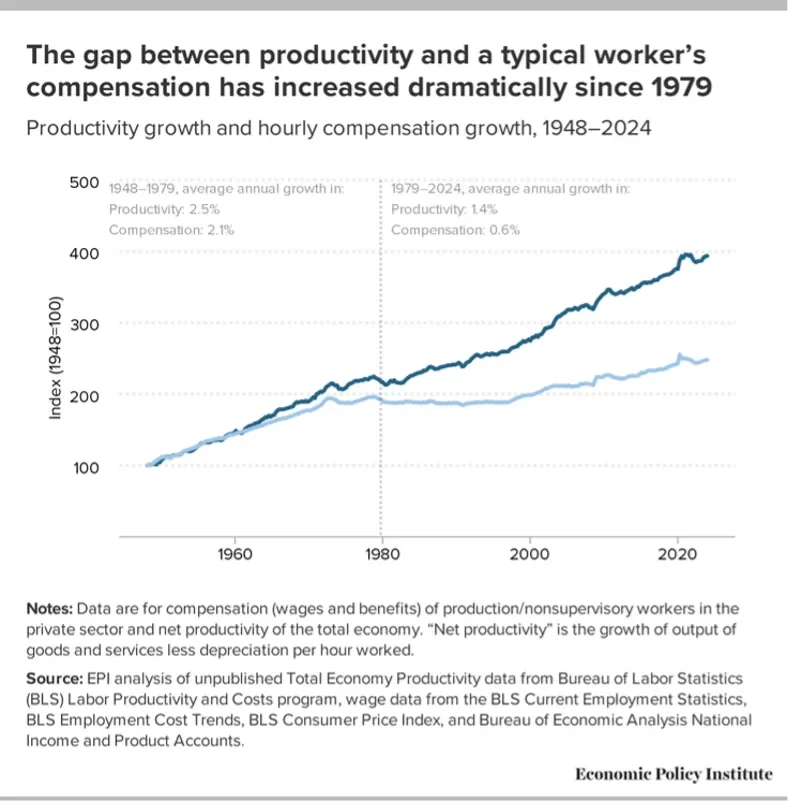
There used to be a time when U.S. wages correlated closely with worker productivity. But in the 1970s things started falling out of sync. Currently, Americans are working the hardest they ever have in recorded history. Productivity is up 81% since 1979. Yet pay has only risen a measly 24%. I emphasize – companies are enjoying record-high profits ($2.8 trillion after taxes) off the labor of hard-working Americans. Yet, employees are making 3.5 times less than they were in 1979, relative to productivity. We deserve a raise…
…but many of us are having trouble simply getting paid what we’re owed. Wage theft doesn’t get as much attention as other types of theft. But whereas shoplifting costs companies an average 7¢ per $100 in sales, American workers are being robbed of as much as $50 billion per year in pay and benefits. Wage theft happens when employers don’t pay their workers what they’re legally entitled. Companies do this by stealing tips, paying less than minimum wage, failing to pay for overtime, or forcing employees to work off-the-clock. In most states, wage theft is not a criminal violation. Labor advocate Jose Uribe tells CBS News, “you can’t go to the police and file a police report for stolen wage...this is largely considered a statutory violation.” That means most thieving employers will never see the inside of a cell – no matter how much steal from their employees. Compare that to property theft – depending on the value of the items, stealing and shoplifting could result in felony charges and, in some states, a potential life sentence. Steal from corporations – face prison time. Steal from workers – at most it’s a misdemeanor and a fine (under federal law).
Worse than wage theft, some Americans are being robbed of their lives while on the job:
Last April, a 26-year-old farm worker died his first day on the job from heat stroke while planting sugar cane in Florida. An OSHA investigation determined the victim’s employer failed to protect him from the 97 degree heat: “Had McNeill Labor Management made sure its workers were given time to acclimate to working in brutally high temperatures with required rest breaks, the worker might not have suffered a fatal injury.” That year McNeill reportedly posted $74.8 million in revenue. How much profit would have been lost from protecting the lives of employees and mandating breaks is unclear.
A month later, a 35-year-old Bank of America associate died suddenly from a heart attack after working a series of back-to-back 100-hour weeks to finish a $2 billion merger project. Leo Lukenas III, a former U.S. Army Green Beret, realized his job was too demanding. Before his death, the husband and father of two had contacted recruiters hoping to find new employment. Though he failed to save himself, he did meet his companies demands; Leo completed the merger just 3 days before he died.
Even children aren’t safe. Although federal law prohibits minors from working hazardous jobs, states and employers skirt around restrictions:
In 2023, a 16-your-old boy was killed in a sawmill accident in Wisconsin after getting pinned to a wood-stacking machine he was attempting to unjam. Wisconsin permits 16-year-olds to work in sawmills. Last year, the governor vetoed a bill that would have expanded the state’s legal working age to 14-years-old without a permit.
That same year, another 16-year-old boy in Missouri was killed working at a landfill after he got pinned between a semi-truck and its trailer. State lawmakers there are currently considering allowing children as young as 14 to work without a permit.
And last year, a poultry plant in Mississippi was hit with 17 OSHA violations after a 16-year-old boy was killed when his body was pulled into a machine he was cleaning in the deboning area.
Since 2021, at least 31 states have introduced bills to weaken child labor protections. Eight have signed them into law.
Americans young and old are killing themselves following orders to satisfy their bosses. According to a Stanford meta-study, work stress is the 5th leading cause of death in the U.S. The World Health Organization has determined more than 745,000 people worldwide die from overworking every year. That’s more than the number of deaths from malaria.
And just like ants who can’t escape the ant mill once they’re trapped, many American workers feel trapped in terrible jobs because companies intentionally make it tough for them to quit. 52% of U.S. employees admit “it would be difficult for them to get the kind of job they’d want if they were to look for a new one.” The New York Times expounds:
“More and more workers now face volatile schedules, unreliable hours and a lack of benefits such as sick leave. The rise of ‘just in time’ scheduling means employees don’t know how many hours they’ll get week to week, making it impossible to budget for rent. Entire industries have been gigified, leaving ride-share drivers, warehouse workers and temp nurses working without benefits, protections or reliable pay. Even full-time jobs in retail and health care — once seen as dependable — are increasingly contracted out, turned into part-time roles or made contingent on meeting ever-shifting quotas.”
It's like economic quicksand – workers are fiercely struggling to get by, but they’re only sinking further into instability. And yet, instead of offering solutions, corporate bosses – with help from our politicians and mainstream media - tell us we’re to blame. The headlines keep coming:
The Wall Street Journal: “How American Workers Got Lazy”
Time: “Why CEOs Actually Deserve their Gazillion Dollar Salaries”
Fox News: “Teachers unions have redefined teaching ‘as selfish and lazy’
Business Insider: “Elon Musk says Americans ‘are trying to avoid going to work at all’”
The Telegraph: “US culture breeds ‘laziness’ and ‘mediocrity,’ says Vivek Ramaswamy as he backs migrant-hiring”
Newsweek: “Republican Suggests Kids Work at McDonald’s Instead of Getting Free Lunch”
This is the messaging Americans are bombarded with to convince us that we’re lucky to have any job – no matter how meager the wage. Benefits - such as health care, hazard pay, overtime and time off - are luxuries. The U.S. is the only advanced economy that doesn’t mandate paid vacation and holidays. The state of the American labor force can sometimes seem as bleak as that of the poor little army ant obediently marching without realizing his inevitable fate.
Fortunately, we’re not ants. Humans are complex pack animals more akin to wolves or orcas, fellow apex predators who thrive through community, collaboration, and close relationships. A recent global study reaffirms the value of robust societal cooperation. A non-profit group lead by professors from Harvard and MIT has developed a “Social Progress Index,” which evaluates countries based on three metrics:
citizen wellbeing (ex. education access and health services)
how well basic needs are being met (ex. housing affordability and safety) and
the level of opportunity for all citizens (think human and civil rights).
Based on the criteria, the United States failed to make the top tier – ranking 31st between Lithuania and Latvia. The researchers offered a sobering assessment, deeming America “an outlier among advanced economies in showing a decline in social progress.” In other words, American society is strikingly mediocre, and our quality of life is only worsening.
The top 3 countries determined by the index are unsurprising: Norway, Denmark, and Finland. There already exists significant discourse on Scandinavian societies, so instead, let’s consider a couple of the other highly rated countries:
Iceland was ranked 6th most successful in providing for its citizens. The government mandates one rest day a week, limits overtime to 48 hours, requires paid leave of 24 to 30 days depending on how long a person has worked at their job, and covers all citizens under universal health care. These are the types of policies that most U.S. politicians – Democrat and Republican – warn will lead to societal and economic collapse. So, what’s the fallout for Icelanders? They enjoy an average life expectancy of 84-years-old, the lowest rates of wealth inequality in the world, and the security of living in the #1 safest country. Iceland’s workers are covered, compensated, and consequently content – the third happiest people in fact.
The Social Progress Index ranked Austria 11th place. But its citizens are the happiest in the world. Its stats are on par with Iceland’s. Their government mandates paid leave for full and part-time workers – up to 6 weeks annual and 16 weeks maternity. Austrians enjoy universal health care, low-income inequality, and a security rating of 5th safest country in the world.
While solidarity and equity bring joy to workers in Austria and Iceland, America’s cutthroat competitive culture leaves its workforce feeling sad, fearful and isolated. 1 in 5 U.S. adults are experiencing mental illness. Most report anxiety, depression and substance abuse. 30% of Americans are lonely. Conversely, Austrians and Icelanders are the least lonely people in the world according to surveys. I don’t think that’s a coincidence - when people feel connected to and supported by their communities and their political representatives, they flourish, availed of the weight of figuring out how to afford necessities. Buying a home, raising children, and retiring comfortably should not be an “American dream.” These should be reasonably attainable goals for people who work hard. But Americans are not taking care of each other.
Collection action has helped other countries: 94% of Iceland’s citizens belong to labor unions. Union membership is 30% in Austria. Compare that to just 9.9% in the U.S – a record low. Earlier I mentioned work productivity and wages used to align in the U.S. until 1979. Coincidentally, that’s the same year union membership began to decline from its peak of 21 million Americans (a quarter of the population) to the current 14 million. But, Americans haven’t just stopped unionizing, they’ve also stopped socializing with their neighbors, joining social clubs, and worshiping together. We’re no longer living as a pack, and as a result, we’ve forfeited the protection and strength that comes collectivity. We’re more divided now than we’ve been in a very long time and its only getting worse.
This is the way the elites want it – they’d rather American workers stay trapped in the spiral so they can benefit from our weakness. Politicians - Republican and Democrat – discourage unity by addressing us in distinct groups and pitting us against one another: immigrants, the LGBT, Black women, White men, Latinos, Jews, etc. Expressing care for other people is now pejoratively called “woke “and vehemently discouraged by rich folks of all stripes - as politically dissimilar as James Carville and Ted Cruz. The richest person in the world is telling the world’s highest-paid podcaster that “empathy” is a “fundamental weakness.” Instead of strengthening our collective power, we’re persuaded to choose a leader to follow: Trump? Bernie? Obama? Joe Rogan? As you decide, an unelected group of corporate elites is in the White House right now firing workers, spending our tax dollars, and promising a new season of “economic hardship.” Something is wrong - most of us feel it viscerally. The question is whether we will keep spiraling like ants or tap into our pack animal instincts and save ourselves.
